Cart
0
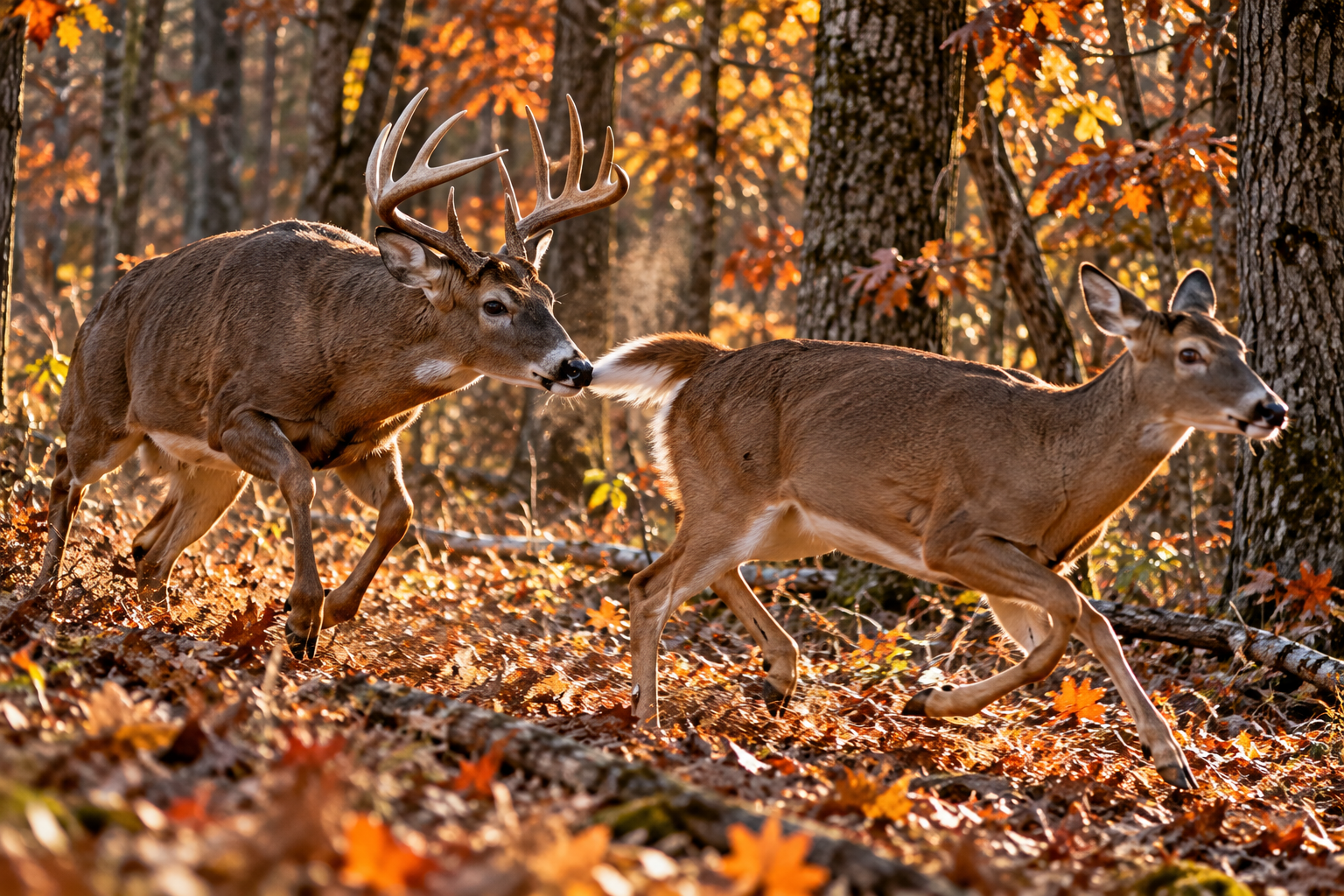
Every autumn, something changes in deer country. The woods may look the same, but the deer are beginning to play by an entirely different set of rules.
There's a moment every deer hunter knows.
Maybe it's the first hard frost of the season. Maybe it's a cold November morning when the woods are so quiet you can hear a squirrel moving through the leaves a hundred yards away.
You're sitting against an old oak tree or watching a narrow opening from your stand. The sun has barely cleared the horizon.
Then you hear it.
Footsteps.
Not the slow, deliberate steps of a deer browsing through the timber. These are hurried, purposeful, almost careless.
A doe slips through the brush.
Seconds later, a buck appears behind her.
His neck is swollen. His nose is close to the ground. His attention is fixed on something far more important than the hunter watching from the shadows.
And just like that, the quiet autumn woods come alive.
For whitetail hunters across America, few events generate more anticipation than the whitetail rut.
It's the season when familiar patterns change, bucks begin covering more ground, and even experienced hunters find themselves wondering what might step into view next.
But the rut is more than a few exciting weeks of deer chasing through the timber.
It's a remarkable biological process shaped by daylight, hormones, reproduction, habitat, and thousands of years of adaptation.
Understanding it can make you a better hunter, a more knowledgeable outdoorsman, and a more observant student of the natural world.
So before you climb into your stand this season, let's take a closer look at what's really happening when the whitetail woods come alive.
1. What Is the Whitetail Rut?
The whitetail rut is the annual breeding season of the white-tailed deer (Odocoileus virginianus).
During this period, bucks experience significant hormonal and behavioral changes as they seek receptive does.
The quiet, cautious buck that spent much of September and October following relatively predictable routines may suddenly begin traveling farther, investigating other deer, challenging competing bucks, and pursuing does.
Some of these changes begin well before peak breeding activity.
That's an important distinction.
The rut isn't a single event that switches on overnight. It's a progression of biological changes and behaviors that develop over time.
And although hunters often describe the rut as the time when bucks are running everywhere, the most visible buck movement doesn't always coincide with the greatest number of does being bred.
In fact, some of the best opportunities to observe traveling bucks can occur before peak breeding, when relatively few does are receptive and bucks are actively searching.
That brings us to one of the most important questions in deer hunting.
What actually starts the rut?
2. What Triggers the Rut? The Science Behind the Season
Ask ten deer hunters what starts the rut, and you may hear ten different answers.
The first frost.
A cold front.
The October full moon.
The first hard freeze.
Or simply the arrival of November.
But the primary environmental signal controlling seasonal reproduction in whitetails is something much more predictable.
Daylight.
More specifically, the changing length of daylight, known as the photoperiod.
The role of shortening days
As autumn progresses and daylight hours decrease, a deer's internal biological systems respond.
Changes in light exposure influence hormonal activity, including melatonin signaling and reproductive hormones.
In bucks, testosterone levels increase as the breeding season approaches.
This contributes to changes in behavior such as rubbing, scraping, sparring, aggression, and increased interest in does.
In does, reproductive hormones regulate estrous cycles and readiness to breed.
These changes help synchronize reproduction within a deer population.
Why timing matters for fawn survival
In much of the northern whitetail range, breeding is concentrated in autumn so that fawns are born during late spring and early summer.
That timing gives young deer access to warmer conditions and abundant vegetation during their earliest months.
A doe's gestation period is approximately 200 days, although individual variation occurs.
A doe bred in November will generally give birth around late May or June.
This seasonal synchronization is especially important in regions with harsh winters.
In warmer southern regions, the reproductive calendar can be much more variable.
Does a cold front trigger the rut?
No.
A cold front may affect when deer move, how comfortable they are traveling during daylight, or how noticeable their activity becomes.
But cold weather doesn't suddenly activate the biological breeding season.
The same distinction applies to moon phases.
The moon may influence nighttime illumination, and hunters continue to debate its effects on movement, but research does not support the claim that a particular full moon determines the date of peak breeding.
The breeding season follows a biological schedule. Weather can change how that schedule looks from a deer stand.
That's a difference every serious deer hunter should understand.
3. The Five Phases of the Whitetail Rut
Hunters commonly divide the rut into several phases.
These categories are useful for understanding deer behavior, but nature doesn't follow a perfectly organized calendar.
Individual bucks and does can behave differently, and the transitions between phases overlap.
Still, recognizing the general progression can help you interpret what you're seeing in the woods.
Phase 1: Pre-Rut — The Anticipation Builds
During the pre-rut, bucks begin displaying increasingly noticeable breeding-related behavior.
Testosterone levels rise.
Bucks may spar with one another, establish dominance relationships, create rubs, and visit scrapes.
Their interest in does begins increasing even though most females in the population are not yet receptive.
For hunters, this can be a fascinating period.
A buck may still spend considerable time near familiar bedding and feeding areas, but his movements can become less predictable as breeding motivation grows.
Signs to watch for:
-
Fresh rubs appearing on saplings and small trees.
-
Increased scrape activity.
-
Bucks investigating scent and other deer.
-
Sparring between bucks.
-
Changes in the timing or frequency of buck sightings.
A useful lesson during this phase is to avoid putting too much confidence in one sign.
A fresh scrape doesn't guarantee that the buck responsible will return during daylight.
A line of rubs may reveal activity, but it doesn't tell you exactly when the animal will appear again.
Instead, combine several observations with your knowledge of the surrounding habitat.
Phase 2: Early Rut — Searching and Seeking
This is when things can get especially interesting.
As the first does become receptive, bucks begin searching more actively.
Some bucks travel beyond their familiar routines, investigating areas where they may encounter females.
Others begin following does, checking scent, and displaying more obvious courtship behavior.
For hunters, this can create opportunities to see bucks that were previously difficult to observe during daylight.
A mature buck may pass through an unfamiliar area while searching for a receptive doe.
But that doesn't mean every buck abandons caution or travels randomly.
Movement still depends on habitat, individual behavior, hunting pressure, and the availability of receptive females.
One of the biggest mistakes hunters make is assuming that every buck will behave the same way during the rut.
Some travel extensively.
Others remain within relatively familiar areas.
And individual movement patterns can change throughout the breeding season.
Phase 3: Peak Rut — When Breeding Takes Center Stage
The term peak rut can be confusing.
Hunters often use it to describe the period of most visible chasing and buck activity.
Wildlife biologists generally focus on the period when the greatest number of does are actually being bred.
Those two peaks don't necessarily occur on the same days.
As more does enter estrus, bucks may spend substantial time tending individual receptive females.
A buck may remain close to a doe rather than continuing to search widely.
This can create the familiar hunting phenomenon sometimes called rut lockdown.
What is rut lockdown?
Rut lockdown describes a period when hunters observe fewer traveling bucks because many are occupied with receptive does.
The deer haven't disappeared.
And the rut hasn't stopped.
Breeding behavior may actually be intense even while visible buck movement seems to decline.
Imagine a buck that spent several days searching for a receptive doe.
Once he finds one, he may remain near her, reducing the time he spends traveling through locations where hunters commonly observe deer.
That's why an apparently slow day in the woods doesn't necessarily mean the breeding season has ended.
Phase 4: Late Rut — The Search Continues
As the majority of adult does finish their receptive periods, breeding opportunities become less common.
Bucks that are still physically capable of breeding may continue searching.
Some may travel in pursuit of the remaining receptive females.
Others begin shifting more attention toward feeding and recovery.
By this stage, many bucks have experienced weeks of increased activity, competition, and reduced feeding opportunities.
Body condition can become increasingly important.
The late rut can still produce exciting encounters, but the patterns may differ considerably from the earlier seeking and chasing phases.
Phase 5: Post-Rut — Recovery and Survival
Eventually, breeding activity declines.
For bucks, the focus increasingly shifts toward rebuilding energy reserves and surviving the coming winter.
Food, shelter, and reduced energy expenditure become important.
However, not every doe necessarily breeds during the primary breeding period.
Some females that were not successfully bred may cycle again, while certain young does may become reproductively mature later in the season.
This can produce additional breeding activity weeks after the primary peak.
Hunters often call this the secondary rut.
It is usually less concentrated and less noticeable than the primary breeding period.
4. When Do Whitetail Deer Rut Across America?
Here's where a nationwide understanding of the rut becomes especially important.
There is no single peak-rut date that applies to every whitetail population in the United States.
In much of the northern and central range, peak breeding is concentrated in November.
But parts of the Southeast and South have remarkably different breeding schedules.
The timing can vary not only between states, but even between regions within the same state.
General regional rut patterns
| Region | Broad breeding pattern |
|---|---|
| Northeast | Commonly concentrated in November |
| Midwest | Often peaks during November |
| Northern Plains | Generally concentrated in November |
| Mid-Atlantic and upper South | Often November, with local variation |
| Deep South | Highly variable; some populations peak in December, January, or later |
| Texas | Considerable variation by ecological region, from early fall into winter |
| Southern Florida and some coastal populations | Can follow unusually early or extended breeding schedules |
These are broad patterns, not exact hunting predictions.
Why southern rut timing can be so different
In northern environments, winter conditions place strong seasonal pressure on reproductive timing.
Fawns born too late may have less time to grow before winter.
In parts of the South, those seasonal pressures differ.
Genetic history, local environmental conditions, and historical deer-restoration efforts have also contributed to regional breeding differences.
Consider Mississippi.
Research and long-term breeding records show that peak conception dates can vary dramatically across the state.
Some populations breed primarily in late fall or early winter, while others peak considerably later.
Texas offers another striking example.
Research by Texas Parks and Wildlife documents substantial differences between ecological regions, with certain coastal populations breeding much earlier than deer in South Texas.
The best way to determine your local rut
Don't rely entirely on a national rut calendar.
Instead, consult your state wildlife agency's breeding-date research, regional maps, and local biological information.
For example, hunters can explore the Texas Parks and Wildlife rut study or the Mississippi deer breeding-date map.
Local observations are useful, but documented conception data provide a stronger foundation for understanding when most breeding occurs.
The calendar matters. But the calendar for your deer herd matters more than someone else's.
5. Reading the Signs: What Rubs, Scrapes, and Tracks Really Tell You
One of the most enjoyable parts of deer hunting is learning to recognize the clues animals leave behind.
During the rut, those clues can become especially interesting.
Rubs: More than antler marks
A buck creates a rub by working his antlers against a tree or woody stem.
Rubbing behavior can serve several functions, including removing velvet earlier in the season and participating in breeding-season communication.
Fresh rubs may indicate that bucks are active in the area.
But don't assume that the size of a rub accurately reveals the size of the buck that made it.
Tree diameter, antler characteristics, and individual behavior all influence the marks left behind.
And one large rub doesn't automatically mean a mature buck lives nearby.
Look for patterns rather than isolated evidence.
Scrapes: A communication network
Scrapes are disturbed patches of ground commonly associated with deer scent communication.
Bucks may paw away leaves and interact with overhanging branches.
Other deer, including does, can investigate these locations as well.
Scrapes can be valuable clues, particularly when considered alongside trails, habitat features, and repeated deer activity.
However, scrape visitation varies with breeding phase, individual deer, and local conditions.
A scrape that looks impressive may receive little activity during the hours you're hunting.
Tracks: Follow the evidence, not the assumptions
Deer tracks can help reveal travel routes and recent activity.
But track size alone isn't a reliable way to identify the age, sex, or antler size of the animal responsible.
Ground conditions can change the appearance of a print considerably.
Several tracks, their direction of travel, and nearby signs can provide more context than one footprint.
For a deeper look at interpreting animal signs, visit our related Wild Route Gear article:
Reading the Woods: How to Recognize Wildlife Signs on Your Next Outdoor Adventure.
The best hunters aren't simply looking for signs.
They're learning how those signs fit together.
6. How the Rut Changes Buck Movement
One of the biggest reasons hunters anticipate the rut is the possibility of increased buck movement.
And research supports the idea that movement can change substantially during the breeding season.
But the story is more complicated than saying that every buck travels farther in November.
Bucks begin searching for receptive does
During the seeking phase, bucks may expand their movements to locate females approaching estrus.
This can result in more frequent travel through unfamiliar areas.
For hunters, it can mean encountering a buck that hasn't previously appeared on a trail camera or along a familiar travel corridor.
However, movement varies by individual and by the timing of breeding in that population.
Mature bucks don't always abandon their home ranges
A common hunting belief is that the rut causes mature bucks to throw caution aside completely.
Some bucks certainly travel extensively.
But others remain relatively close to familiar cover and routes, even while increasing their activity.
Habitat, disturbance, and the distribution of does can influence these decisions.
The rut isn't constant motion
Bucks alternate between searching, tending receptive does, resting, and other activities.
Even during periods of intense breeding motivation, movement isn't continuous.
This explains why one morning can seem filled with activity while the next feels completely uneventful.
It's also why a single disappointing hunt tells you very little about what the local deer population is doing.
A surprising lesson from research
Movement studies can show pronounced seasonal increases in buck travel during breeding periods.
But the month of maximum movement depends on the population's actual rut timing.
A Mississippi buck whose local breeding season peaks in late December may show a very different seasonal movement pattern from a Pennsylvania buck whose local breeding season peaks in November.
The lesson?
Study deer behavior in relation to local breeding dates, not simply the month printed on the calendar.
7. The Truth About Weather, Cold Fronts, and the Rut
Few subjects generate more conversation at deer camp than weather.
Every hunter seems to have a favorite combination.
A falling barometer.
A northwest wind.
A cold front after several warm days.
A frosty morning with barely a breeze.
And while weather can influence deer activity and hunting conditions, it's important to separate observable movement from the timing of reproduction.
Cold fronts can change activity
Cooler temperatures may affect when deer travel and how comfortable they are moving during daylight.
A sudden change in conditions can also coincide with changes in feeding or other behavior.
But a cold front doesn't move the biological peak of breeding forward by several days.
Warm weather doesn't stop the rut
This is one of the most important misconceptions to understand.
A stretch of unusually warm weather may make deer activity less visible to hunters during certain hours.
But receptive does don't simply stop cycling because the afternoon temperature climbs.
The reproductive process continues.
Wind and rain affect the hunting experience
Wind can influence scent movement, animal detection, and how hunters approach a location.
Rain can alter visibility, sound, and the preservation of tracks.
These conditions matter for field decisions.
But none should be confused with the primary biological trigger of the rut.
What about the moon?
The idea of a special rutting moon has been popular for generations.
However, breeding-date research from Pennsylvania found that the median conception date remained relatively consistent despite changes in the timing of the full moon.
That doesn't mean moonlight can never influence an individual deer's activity.
It means moon phase isn't a dependable way to predict when peak breeding will occur.
For serious hunters, the practical takeaway is straightforward.
Pay attention to weather for daily hunting conditions. Look to local reproductive biology for the timing of the rut.
8. Why You May See More Bucks Before Peak Breeding
Here's a detail that can surprise even experienced hunters.
The period when bucks are most visible to hunters may occur before the greatest concentration of actual breeding.
Why?
Because searching requires movement.
When relatively few does are receptive, bucks may travel extensively while trying to locate them.
Once more receptive does become available, individual bucks can spend longer periods tending females.
That can reduce the number of traveling bucks observed along common routes.
This helps explain the familiar experience of seeing several bucks cruising through an area one week, followed by an apparent slowdown.
The slowdown doesn't necessarily mean the rut is over.
It may mean breeding activity has become more concentrated.
What this means for hunting strategy
Instead of treating the rut as one long period of nonstop chasing, consider what the deer may be doing biologically.
Before peak breeding, searching behavior can create movement opportunities.
During concentrated breeding, bucks may remain near receptive does.
Later, remaining breeding opportunities and nutritional recovery can shape activity.
None of these patterns guarantees a successful hunt.
But they provide a better framework for understanding what you observe.
9. Understanding Doe Behavior During the Rut
When hunters discuss the rut, the conversation often centers almost entirely on bucks.
Antler size.
Buck movement.
Scrapes.
Rubs.
Chasing.
But the timing of breeding depends heavily on does becoming receptive.
And that means understanding doe behavior is essential to understanding the rut.
Estrus is a limited window
A doe is receptive to breeding for a relatively short period.
If she isn't successfully bred, she may cycle again several weeks later.
That means different females can become receptive at different times throughout the breeding season.
Does don't all enter estrus simultaneously
Even within a population with a relatively concentrated breeding period, individual females vary.
Age, body condition, and other biological factors can affect reproductive timing.
Doe fawns that reach breeding condition may enter estrus later than adult females.
These differences help explain why some breeding activity can continue after the primary peak.
The importance of female distribution
Bucks are motivated to locate receptive does.
Where females spend time therefore matters.
Food availability, cover, disturbance, and seasonal habitat use can influence where does are found.
Rather than thinking only about where bucks traveled last month, it can be useful to understand where females are spending time now.
During the rut, understanding the does can be just as important as understanding the bucks.
10. Rut Hunting Strategies: Applying What You've Learned
There's no universal formula for hunting the whitetail rut.
Terrain, hunting pressure, regulations, access, and local breeding dates all matter.
Still, understanding the biology can help you make more informed decisions.
Focus on travel corridors
Natural passages between habitat areas can provide opportunities to observe deer movement.
These may include wooded funnels, terrain features, and established routes used by deer.
Avoid assuming every trail is a buck trail or that repeated use guarantees a daylight encounter.
Study the habitat used by does
Because bucks are searching for receptive females, understanding where does feed, rest, and travel can provide valuable context.
That doesn't mean intruding into sensitive bedding areas without considering the consequences.
Unnecessary disturbance can change animal behavior and reduce the quality of the experience.
Use observations over assumptions
Trail cameras, tracks, scrapes, rubs, and direct sightings can all contribute information.
But each has limitations.
A camera records only what passes through its field of view.
A scrape reveals activity at one location.
A single sighting captures one moment.
Combine evidence rather than building an entire strategy around one observation.
Adapt to the breeding phase
During early seeking activity, traveling bucks may be more noticeable.
During peak breeding, some bucks may spend extended periods with receptive does.
During the late and post-rut periods, remaining breeding opportunities and recovery needs may become more important.
Recognizing these changes can help you avoid assuming that every quiet day means something has gone wrong.
Respect the fundamentals
No amount of rut knowledge replaces responsible hunting.
Know your target and what lies beyond it. Follow all current regulations. Use appropriate safety equipment, including a properly fitted full-body harness when hunting from an elevated stand. Practice ethical shot selection and recovery procedures.
And always remember that hunting success is about more than harvesting an animal.
For more on the traditions, preparation, and deeper meaning of deer hunting, explore:
More Than the Hunt: The Tradition, Challenge & Experience of Archery Deer Hunting.
11. Five Whitetail Rut Myths Worth Questioning
Deer hunting is full of traditions, theories, and advice passed from one generation to another.
Some observations contain valuable wisdom.
Others deserve a closer look.
Myth #1: The first hard frost starts the rut
Reality: Seasonal reproductive timing is primarily governed by photoperiod and population biology.
A frost may coincide with noticeable movement, but it doesn't trigger the breeding season.
Myth #2: The full moon determines peak breeding
Reality: Research does not support moon phase as a reliable predictor of peak conception dates.
Local breeding records provide better information.
Myth #3: Every buck travels constantly during the rut
Reality: Buck movement varies widely.
Some bucks travel extensively while searching. Others remain closer to familiar areas or spend time tending receptive does.
Myth #4: If you aren't seeing bucks, the rut must be over
Reality: Bucks may be occupied with receptive females, traveling elsewhere, or moving at times you aren't observing.
Visible activity isn't a perfect measurement of breeding activity.
Myth #5: The rut happens at the same time everywhere
Reality: Rut timing varies across the whitetail's range.
In some northern regions, November is the main breeding period. In parts of the South, peak breeding may occur much later.
The most useful knowledge comes from understanding the deer population you're actually hunting.
12. The Physical Cost of the Rut
For hunters, the rut is exciting.
For bucks, it can be physically demanding.
Searching for receptive does, competing with other males, and tending females all require energy.
During periods of intense breeding activity, bucks may spend less time feeding and more time engaged in reproduction-related behavior.
As a result, some bucks lose substantial body condition over the course of the breeding season.
This has important consequences.
Energy reserves matter
A buck entering the rut in good condition may be better prepared for the physical demands ahead.
After breeding activity declines, feeding and recovery become increasingly important.
In regions with harsh winters, this transition can be particularly significant.
The strongest buck doesn't always breed every doe
Dominance can influence breeding opportunities, but reproduction isn't determined by antler size alone.
Age, condition, timing, location, and access to receptive females all contribute.
Multiple bucks may successfully breed does within the same population.
The rut is a complex biological process, not simply a contest in which the largest-antlered buck wins every time.
Survival is part of the story
The same behaviors that create exciting hunting encounters can expose deer to additional risks.
Increased travel and distraction during breeding can contribute to encounters with roads, vehicles, and other hazards.
Drivers should be especially alert in areas with heavy deer activity during local breeding seasons.
The rut may be one of the most dramatic periods in the whitetail's annual cycle, but it comes with real costs for the animals involved.
13. What the Rut Can Teach Even an Experienced Deer Hunter
One of the things I find most fascinating about deer hunting is that there's always something new to learn.
You can spend decades in the woods and still encounter behavior that challenges what you thought you knew.
A buck appears where you've never seen him before.
A familiar scrape suddenly receives little attention.
A cold morning produces almost no movement, while a mild afternoon delivers the encounter you've been waiting for.
The temptation is to turn every experience into a rule.
But deer rarely cooperate with rules that simple.
The best approach is to remain observant.
Keep notes about the date, weather, location, and behavior you witness.
Compare those observations across multiple seasons.
Learn from wildlife research, but don't ignore the value of careful firsthand experience.
And perhaps most importantly, be willing to change your mind when new evidence appears.
That's what separates simply spending time in the woods from truly studying the animals that live there.
The rut rewards curiosity.
And curiosity is something a hunter should never outgrow.
14. The Magic of November Deer Woods
There's a feeling that settles over deer country as October gives way to November.
It's difficult to explain to someone who has never experienced it.
The woods begin to open as the leaves fall.
Morning air carries the smell of damp earth and decaying foliage.
The last stubborn leaves cling to the branches.
A distant crow breaks the silence.
And somewhere beyond your view, a buck is searching for a doe.
You might sit for hours without seeing anything.
You might watch a young buck chase a doe across an opening.
Or you might witness a mature whitetail moving through the timber with a purpose you've rarely seen at any other time of year.
That's part of what makes the rut so captivating.
You never know exactly what the next few minutes might bring.
For many hunters, the anticipation begins long before opening day.
It's in the preparation.
The early mornings.
The conversations at deer camp.
The stories about the buck that appeared out of nowhere.
And the memories of hunts that didn't end with a harvest but still became unforgettable.
The rut has a way of reminding us why we return to the woods year after year.
Not simply because a big buck might step into view.
But because there's something extraordinary about witnessing nature at work.
Final Thoughts: When the Woods Come Alive
Every autumn, the whitetail rut transforms the behavior of one of North America's most familiar wild animals.
Shortening daylight sets a complex biological process in motion.
Bucks begin searching.
Does become receptive.
Competition increases.
Movement patterns change.
And for a few remarkable weeks—or a different seasonal window in some regions—the woods take on a new kind of energy.
Understanding that process won't guarantee a successful hunt.
It won't tell you exactly when a mature buck will step into an opening.
And it certainly won't eliminate the surprises that make deer hunting so fascinating.
But it can help you appreciate what you're witnessing.
A scrape becomes more than a patch of bare dirt.
A rub becomes more than damaged bark.
A buck traveling through the timber becomes part of a much larger story of instinct, adaptation, and survival.
And maybe that's the greatest reward of learning about the rut.
Not just becoming a better hunter.
But becoming a better student of the woods.
So when the mornings turn cold and the November woods begin to stir, get out there.
Watch closely.
Listen carefully.
And remember that some of the best moments in deer country happen when you least expect them.
The woods are coming alive.
Don't miss the story unfolding around you.
From all of us at Wild Route Gear — hunt responsibly, respect the outdoors, and GO WILD!
Ready for your next adventure? Explore Wild Route Gear for hunting, camping, hiking, and outdoor essentials to help you make the most of your time outside.