Cart
0
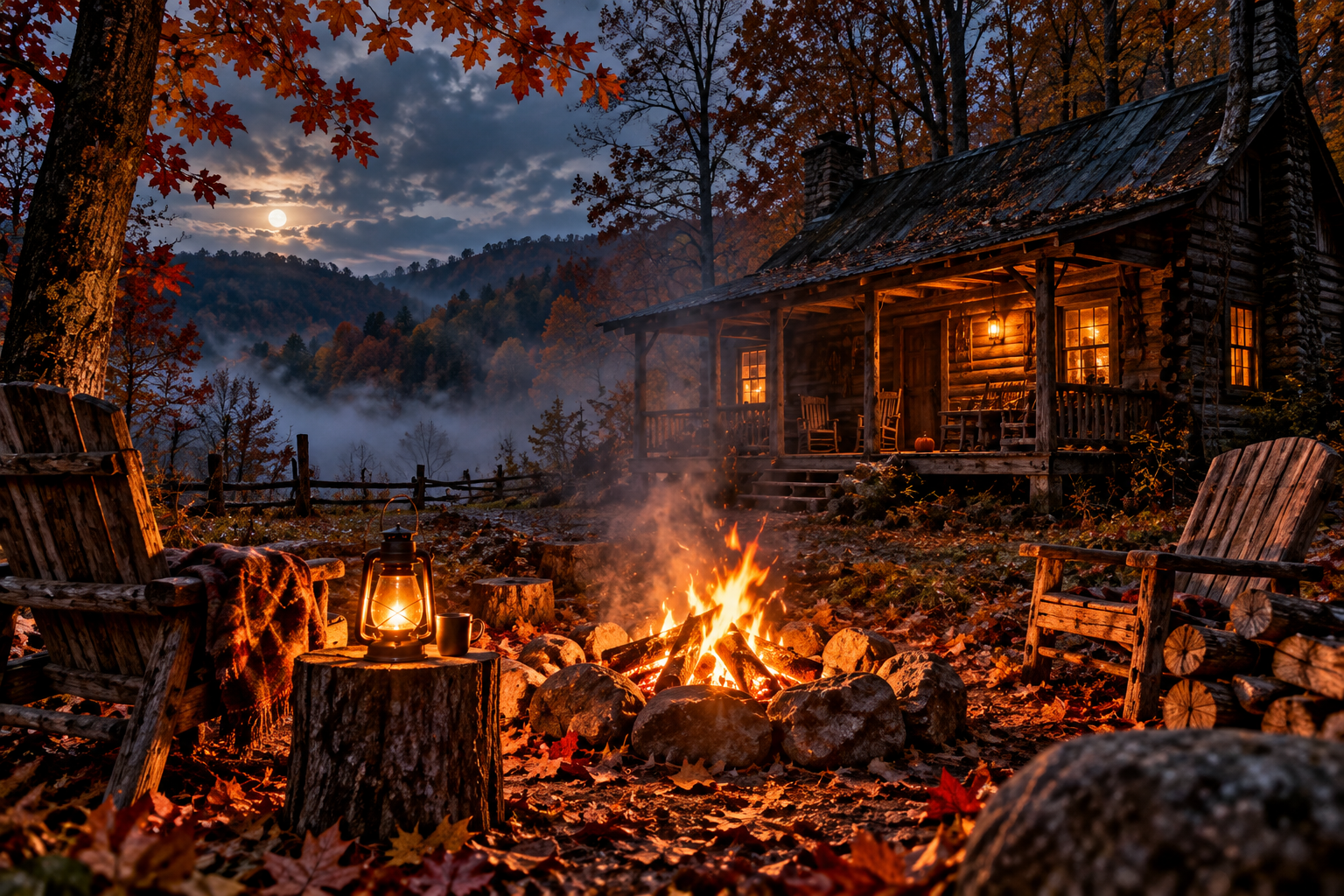
Some stories are best told after dark, when the fire burns low and the woods grow quiet.
There's something about the last days of October that makes the world feel a little different.
The air carries a sharper chill. Smoke drifts from chimneys and campfires. Fallen leaves rustle across old country roads, and the mountains slowly trade their brilliant autumn colors for the bare silhouettes of approaching winter.
Somewhere, a wood fire crackles beneath a pan of cooking sorghum. Families gather to put food away for the cold months ahead. A porch light glows against the darkness, and someone begins telling a story they've heard since childhood.
Maybe it's about a mysterious light seen deep in the mountains. Maybe it's about an old house nobody wants to enter after sundown.
Or maybe it's about a headless rider who appears on a lonely road when the autumn night grows dark.
These are the sights, sounds, and stories that make fall unforgettable.
Long before smartphones, television, and modern entertainment, autumn was a season of hard work, celebration, storytelling, and preparation. Families and neighbors gathered to harvest crops, preserve food, share meals, and enjoy one another's company before winter settled across the countryside.
In the Appalachian Mountains and throughout rural America, many of these fall traditions became treasured parts of community life.
Some survive today. Others live mostly in family memories.
But every October, when the evenings grow longer and the campfires begin to glow, those old traditions seem a little closer.
So pull up a chair, pour yourself something warm, and join us as we explore the harvest gatherings, Appalachian folklore, Halloween legends, and timeless outdoor rituals that make autumn such a magical season.
1. When Autumn Meant Preparing for Winter
Today, fall often means football games, pumpkin patches, Halloween decorations, and weekend trips to enjoy the changing leaves.
For earlier generations, autumn carried a much greater sense of urgency.
The growing season was ending. Gardens were producing their final harvests. Firewood needed stacking, food needed preserving, and homes and farms had to be prepared for the colder months ahead.
Families canned vegetables, dried beans, stored potatoes, gathered apples, and made sure their pantries and smokehouses would carry them through winter.
It was demanding work, but it also brought people together.
Neighbors helped neighbors. Relatives returned home for seasonal gatherings. Children watched and learned skills that had been passed down for generations.
And when the work was finished, there was often food, conversation, music, and storytelling.
These gatherings weren't simply chores or celebrations. They were part of a way of life built around cooperation, self-reliance, and community.
Two traditions in particular capture that spirit beautifully: the sorghum stir-off and the fall hog killing.
2. Sorghum Stir-Offs: The Sweet Smell of Appalachian Autumn
If you've ever experienced an old-fashioned sorghum stir-off, you know it's difficult to forget.
Imagine a cool autumn morning in the mountains.
A wood fire burns beneath a long metal evaporating pan. Steam rises into the chilly air. Nearby, freshly cut sorghum cane waits to be pressed, while family members and neighbors gather around the cooking operation.
The sweet smell of boiling sorghum mixes with woodsmoke.
Someone tends the fire. Someone else watches the syrup. Children linger nearby, hoping for a taste of the finished product.
And all around, conversations unfold.
What is a sorghum stir-off?
Sweet sorghum is a tall, cane-like crop traditionally grown in parts of Appalachia and the rural South.
After the stalks mature, they're harvested and pressed to extract their sweet juice. The juice is then cooked in an evaporating pan, traditionally heated by a wood fire.
As water evaporates, the liquid thickens into rich, dark sorghum syrup.
The process requires careful attention. The cooking syrup must be managed to prevent scorching, and impurities are skimmed from the surface.
In many communities, these events became known as molasses stir-offs, even though the finished product is technically sorghum syrup rather than conventional sugarcane molasses.
But the real magic wasn't just the syrup.
It was the gathering.
More than making molasses
A stir-off could become an all-day affair filled with laughter, conversation, shared meals, and plenty of storytelling.
For children, there was excitement in watching the process and waiting for something sweet.
For adults, it was an opportunity to work together and catch up with relatives and neighbors.
For older generations, it was a chance to pass along knowledge that couldn't easily be learned from a book.
How hot should the fire be? When was the syrup ready? How did you know the cooking had gone just right?
Much of that understanding came from experience.
The Pine Mountain Settlement School in eastern Kentucky has preserved accounts and photographs of sorghum stir-offs, including memories of children enjoying sweet sorghum from pieces of cane.
Those records offer a wonderful glimpse into how deeply the tradition was woven into Appalachian life.
And perhaps that's what makes a sorghum stir-off so special.
A jar of syrup can be purchased.
But the smell of the fire, the sound of familiar voices, and the memories made around that pan are something else entirely.
3. Fall Hog Killings: Hard Work, Community, and Preparing for Winter
Another deeply rooted rural tradition was the fall hog killing, sometimes called hog butchering day.
For generations of farming families, raising hogs provided an important source of meat and fat for the household.
When cooler weather arrived, families often scheduled the annual butchering and preservation of their hogs.
Before modern refrigeration became widespread, cold weather helped make the demanding work of processing and preserving meat more manageable.
But as with sorghum making, the work frequently extended beyond one household.
A day when neighbors came together
A traditional hog killing could involve several generations of family members and trusted neighbors.
There was an enormous amount to accomplish, from processing the meat to preparing sausage, rendering lard, and preserving portions for later use.
The work demanded skill, cooperation, and an understanding of food preservation.
Different people often took responsibility for different tasks, based on their experience and abilities.
The goal was to make practical use of the animal and provide food for the family.
Nothing was taken lightly.
For many rural households, the meat produced during these gatherings represented a significant part of their winter food supply.
The memories surrounding the work
For people who remember these gatherings, the strongest memories aren't always about the labor itself.
They're about the people.
The smell of woodsmoke on a cold morning. The sound of relatives talking across the yard. A large meal prepared for everyone helping. The older family members who seemed to know exactly what needed doing without anyone giving instructions.
Children watched, carried out small chores, and absorbed lessons about responsibility, food, and rural life.
Some remember the day fondly. Others remember how difficult and physically demanding it was.
Both perspectives are part of the tradition's history.
These gatherings reflected a time when food didn't simply arrive packaged from a store. Families understood where it came from, how much work it required, and why careful preparation mattered.
Today, the practice is less common in many communities, but its place in rural Appalachian heritage remains significant.
And the broader lesson still resonates: some of the strongest traditions are built when people come together to accomplish something important.
4. The Campfire: Where Stories Became Traditions
After a long autumn day, few things are more inviting than a campfire.
The warmth draws everyone closer. The flames cast moving shadows across nearby trees. Sparks rise into the darkness, and conversations seem to become more meaningful as the evening grows quiet.
For generations, fires have provided a gathering place for storytelling.
Families shared memories. Hunters recounted remarkable encounters in the woods. Travelers exchanged tales about strange places and unusual experiences.
And inevitably, someone would tell a ghost story.
Why ghost stories belong around a fire
A campfire creates the perfect setting for a little mystery.
Beyond the circle of firelight, the world becomes difficult to see. Familiar sounds seem louder. A branch cracks somewhere in the darkness. Leaves move when there doesn't appear to be any wind.
The storyteller pauses.
Everyone listens.
Was that just an animal moving through the brush?
Probably.
But for a few wonderful moments, nobody is entirely certain.
That's the fun of an old-fashioned campfire tale.
The story doesn't have to be true to become a treasured memory. It simply needs a good storyteller, an attentive audience, and enough imagination to make the darkness feel alive.
5. Appalachian Folklore: Strange Lights, Mountain Legends, and Mysterious Woods
The Appalachian Mountains have a rich storytelling heritage shaped by generations of people, places, and cultural influences.
Stories passed down through families often featured unusual encounters, mysterious sounds, haunted locations, and unexplained lights.
Some tales were meant to entertain. Others served as warnings, moral lessons, or explanations for events people didn't understand.
Many changed as they traveled from one storyteller to another.
The mysterious lights in the mountains
One enduring Appalachian mystery involves the Brown Mountain Lights of North Carolina.
For generations, people have reported seeing unusual lights in the area around Brown Mountain.
Explanations have included atmospheric conditions, distant artificial lights, and other natural phenomena, while folklore has supplied more supernatural interpretations.
The mystery became part of the region's identity.
Whether someone approaches the subject as folklore, local history, or an interesting natural phenomenon, the story illustrates how easily an unusual sight can capture the imagination.
The old cabin at the end of the road
Nearly every rural community seems to have its own version of this story.
There's an abandoned house somewhere beyond the last occupied farm.
The windows are broken. The porch leans. The road leading to it is nearly swallowed by weeds.
Someone claims they once saw a light in an upstairs window.
Someone else insists they heard footsteps when nobody was inside.
And before long, the building has a reputation.
Stories like these don't need to be tied to a particular historical event to become memorable folklore. Sometimes the mystery grows from the setting itself.
An old cabin, an overgrown cemetery, or a forgotten trail can inspire generations of imaginative storytelling.
The important thing is to enjoy the stories while remembering that folklore and verified history are not necessarily the same.
Why the mountains inspire such powerful tales
Appalachian forests can be extraordinarily atmospheric.
Fog settles into valleys. Wind moves through bare branches. Shadows stretch across narrow hollows as the sun disappears behind the ridges.
An owl calls from a distant tree.
A coyote answers somewhere across the mountain.
And suddenly, an ordinary October evening feels like the beginning of a ghost story.
It's little wonder that these landscapes have inspired so many legends.
6. The Legend of Sleepy Hollow: America's Great Autumn Ghost Story
Of all the stories associated with Halloween, few capture the feeling of an autumn night quite like The Legend of Sleepy Hollow.
Written by Washington Irving and first published in 1820, the story is set in New York's Hudson River Valley, far from the Appalachian Mountains.
Yet its atmosphere of rural traditions, harvest gatherings, lonely roads, and supernatural rumors makes it a natural companion to the American autumn storytelling tradition.
And at its center stands one of the most unforgettable figures in American literature.
The Headless Horseman.
A schoolteacher with an imagination
The story follows Ichabod Crane, a schoolteacher with a strong appetite for food, superstition, and ghostly tales.
Ichabod becomes interested in Katrina Van Tassel, the daughter of a prosperous farmer, but he faces competition from the confident and mischievous Brom Bones.
One autumn evening, Ichabod attends a gathering at the Van Tassel home.
There is food, dancing, conversation, and storytelling.
Among the tales circulating that night are frightening accounts of the Headless Horseman, a ghostly rider associated with a soldier who supposedly lost his head during the Revolutionary War.
The ride through the darkness
After the gathering, Ichabod travels home alone.
The night is dark. The countryside is quiet. Every shadow seems suspicious.
As he rides, he encounters a mysterious horseman.
The rider appears to have no head.
And before long, Ichabod finds himself in a terrifying race through the night.
The mysterious horseman pursues him toward a bridge, and the encounter ends with a startling object hurtling through the darkness.
By morning, Ichabod has disappeared.
The story leaves readers wondering what really happened.
Was the Headless Horseman a supernatural figure?
Or had someone taken advantage of Ichabod's fears and vivid imagination?
Irving leaves room for doubt, and that uncertainty is part of the story's enduring charm.
Why Sleepy Hollow still belongs to October
What makes The Legend of Sleepy Hollow so effective isn't simply the Headless Horseman.
It's the setting.
The harvest gathering. The country roads. The dark trees. The distant sounds of the night.
Irving understood that a familiar landscape can become frightening when imagination takes over.
More than two centuries later, the story remains a wonderful choice for a late-October reading beside the fireplace or around a campfire.
And perhaps that's the secret to a truly great ghost story.
It doesn't need to convince you that ghosts are real.
It only needs to make you glance over your shoulder once or twice.
7. Halloween Traditions: From Old Superstitions to Jack-o'-Lanterns
Halloween didn't begin with plastic skeletons, candy buckets, and elaborate yard decorations.
Many of its traditions developed over centuries through a combination of seasonal celebrations, religious observances, folk beliefs, and changing cultural customs.
The ancient Celtic festival of Samhain is often discussed as an important influence on Halloween.
Associated with the transition from the harvest season into winter, Samhain carried traditions and beliefs concerning seasonal change and the spirit world.
Over time, customs associated with All Hallows' Eve and later Halloween evolved through different communities and historical periods.
Before pumpkins, there were turnips
One of Halloween's most familiar traditions is carving a glowing face into a pumpkin.
But earlier versions of jack-o'-lanterns in Ireland and other parts of Britain were made from vegetables such as turnips.
Folklore associated these lanterns with spirits and stories such as that of Stingy Jack, a wandering figure who carried a light.
As Halloween customs developed in North America, pumpkins became closely associated with the tradition.
Today, a glowing jack-o'-lantern on a porch is one of the most recognizable symbols of October.
The old-fashioned Halloween gathering
Long before today's elaborate Halloween attractions, seasonal gatherings could feature simple games, homemade treats, storytelling, and a little playful superstition.
Families and neighbors might gather for food, conversation, and entertainment.
The fun came from being together.
And for those living in rural areas, the surrounding darkness and autumn weather supplied all the atmosphere anyone could ask for.
8. When the Woods Come Alive After Dark
Have you ever been sitting around a campfire when a strange sound suddenly interrupted the conversation?
Maybe it was a sharp scream in the distance.
A low howl from somewhere beyond the trees.
Or the unmistakable sound of footsteps moving through dry leaves.
The woods can sound surprisingly mysterious after dark.
But many of those unsettling noises have perfectly natural explanations.
Owls: The voices in the darkness
Owls are among the most memorable nighttime voices in the forest.
Different species produce hoots, whistles, screeches, and other calls that can sound remarkably strange to someone unfamiliar with them.
A barred owl, for example, has a distinctive series of calls that can carry through wooded areas.
Hearing one from an unseen tree can be an unforgettable experience.
Coyotes: A chorus across the hills
Coyotes communicate through yips, barks, howls, and other vocalizations.
When several call together, the sound can seem to come from a much larger group than is actually present.
Their calls can travel across open country and through valleys, creating an eerie nighttime soundtrack.
Foxes, deer, and rustling leaves
Foxes can make surprisingly sharp vocalizations, while deer and other mammals may produce snorts, grunts, or movement noises.
Dry leaves amplify footsteps.
Branches fall.
Wind shifts through the trees.
And small animals moving nearby can sound much larger than they really are.
Learning to recognize wildlife sounds can make nighttime outdoor experiences both more interesting and less intimidating.
For more on understanding the evidence animals leave behind, explore our guide to Reading the Woods: How to Recognize Wildlife Signs on Your Next Outdoor Adventure.
After all, sometimes the most mysterious sound in the woods is simply nature going about its business.
9. Forgotten Fall Traditions Worth Bringing Back
Not every meaningful tradition needs to be complicated.
In fact, some of the best autumn memories come from the simplest activities.
Gather around a fire and tell stories
Invite family or friends for an evening of campfire storytelling.
Ask older relatives to share memories from their childhood. Encourage everyone to bring a favorite ghost story, hunting memory, or tale about an unforgettable outdoor adventure.
You might be surprised how many stories you've never heard before.
Visit a sorghum festival or heritage demonstration
Community festivals and historical demonstrations can provide opportunities to see traditional syrup making and other rural skills.
Watching experienced craftspeople at work offers a connection to the past that photographs and descriptions alone can't provide.
And a taste of real sorghum syrup on a warm biscuit is a pretty good bonus.
Share an old family recipe
Autumn is a wonderful time to bring back recipes associated with earlier generations.
Homemade apple butter, beans and cornbread, fresh biscuits, sorghum syrup, and other traditional foods can connect a meal with family history.
Better yet, ask someone who remembers the original recipe to help prepare it.
Take a family walk through the fall woods
You don't need a major expedition to enjoy the season.
Choose a familiar trail, walk slowly, and enjoy the sounds, smells, and colors of the woods.
Look for wildlife signs. Gather photographs rather than disturbing natural objects. Talk about the places your family visited years ago.
Sometimes the simplest outdoor traditions are the ones children remember longest.
Bring back the storytelling porch
Not every fall gathering needs a campfire.
A porch, a few chairs, warm drinks, and a chilly evening can provide everything necessary for a memorable conversation.
Put the phones away for a while.
Let the stories unfold.
You may discover that the best entertainment has been sitting beside you all along.
10. Creating Your Own Autumn Campfire Tradition
One of the most rewarding things about outdoor traditions is that you don't have to inherit one to begin one.
You can start something this year that becomes part of your family's October memories for decades.
Imagine an annual late-October gathering.
A few friends arrive before sunset. Everyone brings something warm to eat. A pot of cider is ready, and a small, safely managed fire provides warmth as the evening cools.
When darkness settles over the trees, the stories begin.
Someone shares a childhood memory.
Someone else recalls an unforgettable hunting or camping experience.
And eventually, somebody tells a ghost story.
Maybe it's The Legend of Sleepy Hollow.
Maybe it's an old Appalachian tale.
Or maybe it's a mysterious encounter that supposedly happened just down the road.
Make it memorable and safe
A little planning goes a long way.
-
Choose an established, permitted fire area and follow local fire restrictions.
-
Keep the fire manageable, with water and suitable extinguishing equipment nearby.
-
Never leave a fire unattended, and extinguish it completely before leaving.
-
Dress for cold weather and bring extra layers.
-
Use lanterns or flashlights to illuminate walking areas.
-
Supervise children and pets around fire and hot cooking equipment.
-
Prepare food safely, especially when handling or storing perishable items.
-
Respect the surrounding wildlife and keep noise at reasonable levels.
For families who want to turn the evening into a weekend outdoors, our Ultimate Camping Checklist offers practical ideas for preparing your gear and supplies.
The important thing isn't how elaborate the gathering becomes.
It's making time to be together.
11. The Stories We Carry Home
There's a reason certain memories return every autumn.
Sometimes it's a smell.
Woodsmoke drifting through cold air.
Fresh sorghum cooking over a fire.
A familiar meal being prepared in an old kitchen.
Sometimes it's a sound.
The creak of a porch swing.
Leaves rustling across a country road.
A grandparent's voice beginning a story you've heard a hundred times but still want to hear again.
And sometimes it's simply the feeling of being outdoors with people who matter to you.
The old sorghum stir-offs and hog-killing gatherings weren't created to become nostalgic traditions. They were part of everyday life, shaped by the work required to feed families and prepare for winter.
The stories told around fires weren't necessarily intended to become treasured folklore. They were ways to entertain, teach, remember, and connect.
But somewhere along the way, those ordinary moments became extraordinary memories.
And that's worth thinking about.
The traditions we remember most fondly often began with someone simply taking the time to bring people together.
The Magic of Fall Is More Than the Changing Leaves
Autumn has a way of reminding us that some things are worth slowing down for.
A quiet morning in the woods.
An old family recipe.
The warmth of a campfire.
The laughter of friends gathered on a chilly evening.
And perhaps a good ghost story when the shadows grow long.
Whether you grew up around Appalachian sorghum stir-offs, remember the hard work of traditional fall hog killings, or simply love the thrill of hearing about the Headless Horseman on an October night, these traditions share something important.
They connect us to the people and places that came before us.
They remind us that outdoor life has always been about more than recreation.
It's about heritage, community, resourcefulness, and the memories we carry forward.
So this fall, make time for an old tradition.
Better yet, begin a new one.
Gather around the fire. Tell a story. Share a meal. Take someone you love into the autumn woods.
Because years from now, those may be the moments everyone remembers.
And if you happen to hear hoofbeats on a lonely road after dark…
Well, it probably wouldn't hurt to head home before midnight.
From all of us at Wild Route Gear — keep the traditions alive, enjoy the adventure, and Go Wild!
Looking forward to your next outdoor gathering? Explore Wild Route Gear for camping, hiking, outdoor, and sporting essentials to help you make more memories outside.