Cart
0
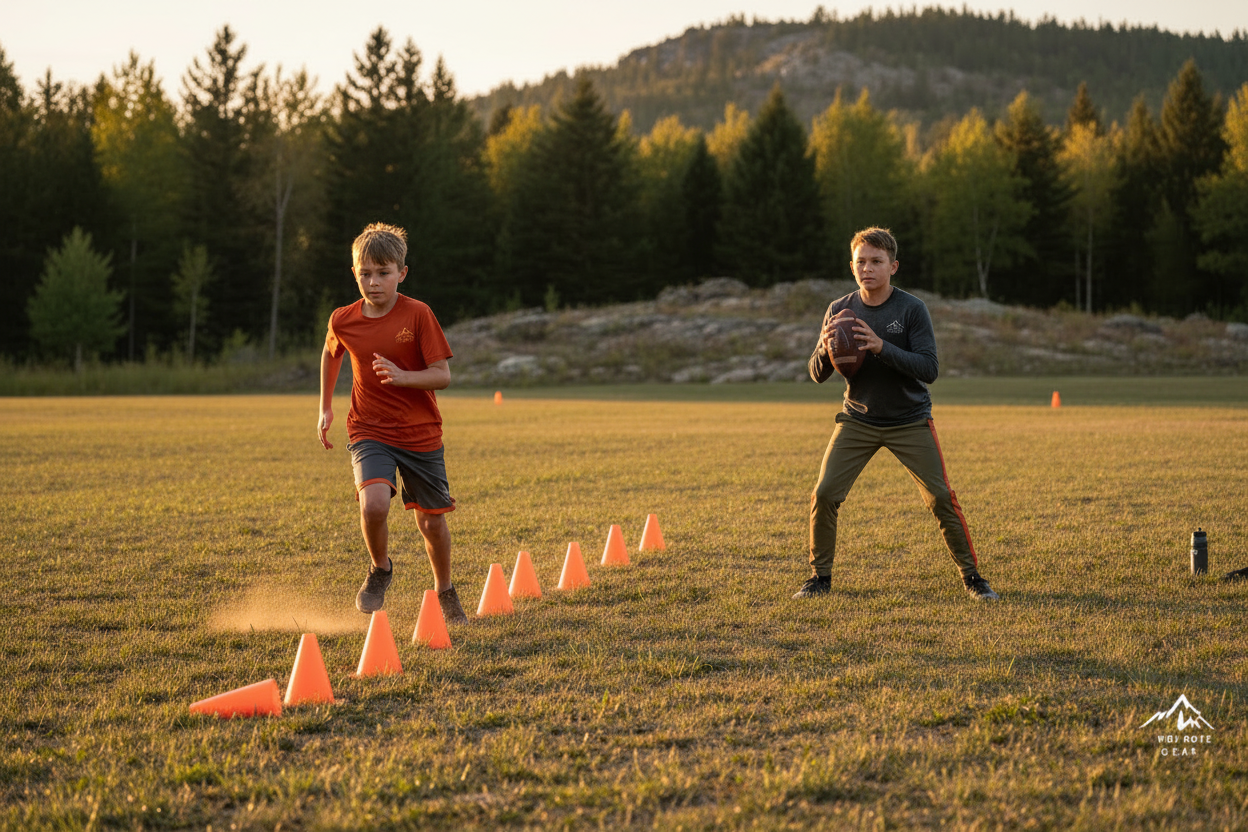
You don't need a full football field, a team of players, or an expensive training facility to improve your football skills.
With a football, a little open space, and a consistent practice routine, you can work on important fundamentals right in your backyard, driveway, or local outdoor space.
Whether you're a young player getting ready for the season, a parent looking for football drills for kids, or an experienced athlete who wants to sharpen skills between practices, training at home can be a great way to build confidence and develop better habits.
The key is consistency.
Spending 20 to 30 minutes practicing the right football drills several times a week can help improve your footwork, coordination, ball control, catching, passing, agility, and overall athletic ability.
In this guide, we'll cover 15 football drills you can do at home with minimal equipment. Most can be adapted for beginners, youth players, and more experienced athletes.
Why Practice Football at Home?
Team practices are important, but they aren't the only opportunity you have to improve.
Practicing at home gives you the freedom to focus on specific skills that may need extra attention. You can repeat a movement many times without waiting for your turn, and you can work at a pace that's appropriate for your current ability.
Home football training can help you:
- Improve fundamental football skills
- Develop better footwork
- Improve hand-eye coordination
- Build agility and balance
- Practice catching and passing
- Develop faster reactions
- Improve conditioning
- Build confidence
- Create better muscle memory
- Stay active during the offseason
The best part is that many football drills require very little equipment.
A football, a few cones or markers, and a safe area to practice can be enough to get started.
What You Need for Football Training at Home
Before starting your workout, gather the equipment you'll need.
For most of the drills in this guide, you can use:
- Football
- Cones or training markers
- Athletic shoes
- Comfortable athletic clothing
- Water
- Stopwatch or phone timer
- Training partner, when available
You can also add equipment such as agility ladders, practice nets, throwing targets, or other football training equipment as your training routine develops.
If you're practicing alone, don't worry. Many of these drills can be modified for solo training.
1. Quick Feet Drill
Footwork is an important part of football for players at every position.
The quick feet drill is a simple way to work on speed, coordination, balance, and body control.
How to do it:
- Place two markers about 3 to 5 feet apart.
- Stand beside one marker.
- Move your feet quickly in place for 10 to 15 seconds.
- Shuffle toward the second marker.
- Repeat the quick-foot movement.
- Continue moving back and forth.
Focus on staying light on your feet rather than taking large steps.
Try this:
Perform 3 to 5 rounds of 15 seconds with a short rest between rounds.
As your footwork improves, increase the duration or add directional changes.
2. Cone Shuffle Drill
Lateral movement is essential for many football positions.
The cone shuffle helps develop side-to-side movement while teaching you to stay balanced and under control.
How to do it:
Set up three cones in a straight line, approximately 3 to 5 feet apart.
Start at the center cone.
Shuffle quickly toward one outside cone, touch the ground, and then shuffle across to the opposite cone.
Return to the center and repeat.
Keep your chest up and avoid crossing your feet.
Training goal:
Complete 3 to 5 sets while maintaining good technique.
Speed matters, but controlled movement is more important than simply moving as fast as possible.
3. Forward and Backpedal Drill
Football players need to move forward, backward, and laterally while maintaining body control.
This drill is especially useful for developing defensive movement.
How to do it:
Place two cones approximately 5 to 10 yards apart.
Start at one cone.
Sprint forward toward the second cone.
When you reach it, turn and backpedal toward the starting point.
Repeat several times.
Focus on keeping your knees bent and maintaining control during the transition.
Make it harder:
Add a lateral shuffle before or after the backpedal.
You can also have a training partner point in different directions and tell you where to move.
4. Figure-Eight Cone Drill
The figure-eight drill combines footwork, agility, balance, and directional changes.
Setup:
Place two cones about 5 yards apart.
Run around them in a figure-eight pattern.
Try to stay low and make smooth turns around each cone.
Focus on:
- Quick changes of direction
- Staying balanced
- Short steps around the cones
- Maintaining control
- Accelerating out of each turn
Complete 3 to 5 rounds and rest between attempts.
As you improve, increase the speed while maintaining good technique.
5. Sprint and Stop Drill
Being able to accelerate quickly is valuable in football.
So is being able to stop under control.
This simple drill works on both.
How to do it:
- Mark a starting point.
- Place another marker approximately 10 yards away.
- Start in an athletic stance.
- Sprint toward the marker.
- Slow down and stop under control.
- Walk back to the starting point.
- Repeat.
Perform 5 to 10 repetitions.
Don't focus solely on maximum speed. Practice accelerating smoothly and stopping without losing your balance.
6. Football Ball Drops
Hand-eye coordination is fundamental for catching a football.
If you don't have a partner, you can still practice catching skills.
How to do it:
Hold the football in one hand.
Drop it slightly in front of you and catch it with the opposite hand.
Alternate hands with every repetition.
As you become more comfortable, increase the height of the drop.
Challenge:
Try dropping the football from shoulder height or slightly to one side.
This forces you to react rather than simply catching the ball from the same position every time.
7. Self-Toss Catching Drill
The self-toss drill is another simple football catching exercise that can be performed alone.
How to do it:
- Hold the football in both hands.
- Toss it a short distance into the air.
- Track the ball with your eyes.
- Catch it securely.
- Repeat.
Start with easy catches and gradually make the tosses more challenging.
Try tossing the ball slightly to the left and right.
Remember the basic principle:
Watch the football all the way into your hands.
8. One-Hand Catching Drill
Once you've developed confidence with basic catches, you can begin working on one-handed catches.
This should be approached as a coordination exercise rather than a replacement for proper two-handed catching technique.
How to do it:
Toss the football slightly to one side.
Reach with one hand and attempt to secure the ball.
Alternate sides.
Start with short, easy throws and gradually increase the distance.
Important:
Don't sacrifice good catching mechanics simply to make a difficult catch.
For younger players especially, focus on learning reliable two-handed catching before making one-handed catches a major part of training.
9. Target Throwing Drill
Quarterbacks and other players who throw the football can work on accuracy without needing a full team.
All you need is a safe target.
Your target could be a properly positioned training net, target, or another suitable object.
How to do it:
- Establish a throwing line.
- Place your target at a safe distance.
- Throw the football toward the target.
- Focus on consistent mechanics.
- Repeat from different distances.
Start close to the target.
Once your accuracy improves, gradually increase the distance.
Track your progress
Keep track of how many accurate throws you make out of 10.
For example:
Week 1: 6/10
Week 2: 7/10
Week 3: 8/10
Simple measurements like this can make your progress easier to see.
10. Passing Footwork Drill
Good passing starts with good footwork.
This drill helps you practice setting your feet before throwing.
How to do it:
Start in an athletic stance.
Take a few quick steps forward, establish your throwing position, set your feet, and make a controlled pass toward your target.
Reset and repeat.
Focus on:
- Balance
- Foot placement
- Upper-body control
- Consistent release
- Accuracy
Avoid rushing through the movement.
The goal is to develop repeatable mechanics.
11. Route Running Cone Drill
You don't need teammates to practice running routes.
Set up cones to create a simple route pattern and practice your cuts.
Try these routes:
- Slant
- Out
- In
- Curl
- Comeback
- Corner
Start with simple patterns.
Run toward the first cone, make your cut, and accelerate through the next portion of the route.
Focus on making sharp, controlled cuts rather than simply running as fast as possible.
12. Catch-and-Turn Drill
This drill combines catching with the transition that happens immediately afterward.
If you have a partner, have them make a short pass.
Catch the football securely, turn quickly, and accelerate toward a predetermined marker.
If you're practicing alone, toss the ball into the air, catch it, turn, and sprint toward your marker.
Focus on:
- Catching the football securely
- Protecting the ball
- Turning efficiently
- Accelerating after the catch
This helps connect separate skills into one movement.
13. Reaction Drill
Football is a reaction-based sport.
Players need to respond quickly to movement, sound, and changes in direction.
A simple reaction drill can help develop this skill.
With a partner:
Have your partner stand several yards away.
They can point left, right, forward, or backward.
React to their signal and move in that direction.
Solo version:
Use a timer or random audio cues to determine when you change direction.
You can also use numbered cones and have a partner call out a number.
The goal is to react rather than anticipate.
14. Shuttle Run
The shuttle run is a classic football conditioning drill.
It combines acceleration, deceleration, changes of direction, and conditioning.
Setup:
Place three markers approximately 5 yards apart.
Start at the center.
Sprint to one outside marker.
Touch the ground.
Sprint across to the opposite marker.
Touch the ground.
Finish back at the center.
Rest and repeat.
Training tip:
Don't sacrifice technique as you get tired.
Keep your body under control during each change of direction.
Start with 3 to 5 repetitions and increase gradually.
15. Football Conditioning Circuit
Instead of performing one drill at a time, combine several movements into a short football training circuit.
For example:
Round 1
- 20 seconds quick feet
- 10-yard sprint
- 10-yard backpedal
- 10 cone shuffles
- 5 football catches
Rest for 60 to 90 seconds.
Repeat 3 to 5 rounds.
You can change the exercises each session to keep your workouts interesting.
The goal isn't to completely exhaust yourself every time.
Consistent, quality practice is more valuable than occasional workouts that leave you completely exhausted.
How Long Should You Practice Football at Home?
You don't necessarily need a long workout to make progress.
For many players, a focused 20- to 30-minute session can be enough to work on specific skills.
Here's an example:
5-Minute Warm-Up
- Light jogging
- High knees
- Butt kicks
- Dynamic stretches
- Easy footwork
10 Minutes of Skill Work
Choose two or three drills.
For example:
- Catching
- Passing
- Footwork
10 Minutes of Agility or Conditioning
Choose:
- Cone drills
- Shuttle runs
- Sprints
- Backpedals
5-Minute Cooldown
Walk slowly and perform gentle stretches.
Adjust the intensity and duration to your age, fitness level, experience, and training goals.
How Often Should You Practice Football?
Consistency is more important than trying to practice every single day.
A beginner might start with two or three training sessions per week.
More experienced athletes may incorporate additional skill work into their regular training schedule.
The important thing is to give your body time to recover.
A simple weekly schedule could look like:
Monday: Football skills
Tuesday: Rest or light activity
Wednesday: Football skills
Thursday: Rest
Friday: Football skills
Saturday: Optional recreational practice
Sunday: Rest
Your actual schedule should depend on your age, team practices, conditioning program, and overall workload.
Tips for Better Football Training at Home
Focus on quality over quantity
Performing 100 sloppy repetitions won't necessarily help as much as performing 25 controlled repetitions correctly.
Practice both sides
If a drill can be performed using either side of your body, practice both.
Developing balance and coordination on both sides can make you a more versatile athlete.
Track your progress
Keep a simple training log.
Record things like:
- Number of catches
- Accurate throws
- Sprint times
- Number of repetitions
- Drill difficulty
- How you felt during the workout
Seeing improvement over time can help keep you motivated.
Make your workouts challenging—but manageable
Your training should challenge you without constantly pushing you to exhaustion.
Increase difficulty gradually.
Stay hydrated
Have water available before, during, and after training, particularly when practicing outdoors in warm weather.
Warm up first
Don't jump straight into maximum-speed sprints.
Use a dynamic warm-up to gradually prepare your body for activity.
How to Create a Backyard Football Training Area
You don't need a giant backyard to create a useful football practice space.
A small, organized training area can be enough for many drills.
Start with:
- A safe open area
- Football
- Cones
- Training markers
- Practice target or net
- Water
- Storage for equipment
If you have additional space, you can create separate areas for different skills.
For example:
Area 1: Footwork
Use cones for agility drills.
Area 2: Passing
Set up a safe throwing target.
Area 3: Catching
Create a space where a partner can throw passes.
Area 4: Conditioning
Use a measured sprinting area.
A dedicated training space makes it easier to practice consistently because your equipment is organized and ready to use.
Football Training Safety Tips
Training at home can be effective, but safety should always come first.
Before beginning:
- Make sure your practice area is clear of obstacles.
- Check the surface for holes, rocks, or other hazards.
- Wear appropriate athletic footwear.
- Warm up before intense activity.
- Stay hydrated.
- Avoid training in dangerous weather conditions.
- Follow proper technique.
- Take breaks when needed.
- Don't train through significant pain or injury.
- Younger athletes should have appropriate adult supervision.
If you're training at a public location, follow the rules for that facility and be considerate of other people using the space.
Make Your Football Training More Fun
Football training doesn't have to feel like a chore.
Mix up your workouts by creating challenges.
For example:
Accuracy Challenge
How many accurate throws can you make out of 20?
Catching Challenge
How many consecutive catches can you make without dropping the football?
Speed Challenge
Can you improve your shuttle time?
Footwork Challenge
Can you complete a cone course without touching a marker?
You can also practice with friends or family members.
A little friendly competition can make training more enjoyable and help keep you motivated.
Build Your Football Training Gear Collection
As your training routine develops, you may find that a few pieces of equipment can make practicing at home easier and more productive.
Cones and markers can help create agility courses and route patterns. Practice nets and targets can provide a consistent place to work on throwing accuracy. Additional outdoor sports equipment can help you expand your training routine as your skills improve.
At Wild Route Gear, our goal is to help outdoor enthusiasts, athletes, families, and adventurers get the gear they need to spend more time doing what they love.
Explore our selection of outdoor and team sports equipment to build your own practice setup.
Final Thoughts
You don't need a professional training facility to become a better football player.
With a football, a safe practice area, and a consistent routine, you can work on important skills almost anywhere.
The 15 football drills in this guide can help you develop footwork, agility, coordination, catching, passing, reaction time, conditioning, and overall athletic ability.
Start with a few drills that match your current skill level.
Master the fundamentals.
Track your progress.
Then gradually increase the difficulty as your skills improve.
Most importantly, make practice something you enjoy.
Whether you're preparing for your first youth football season, trying to earn more playing time, getting ready for the next game, or simply enjoying a game of football with friends and family, a little extra practice can go a long way.
Get outside. Get moving. Get better.
Go Wild!
#GoWild #WildRouteGear #TheWildRouteGear